
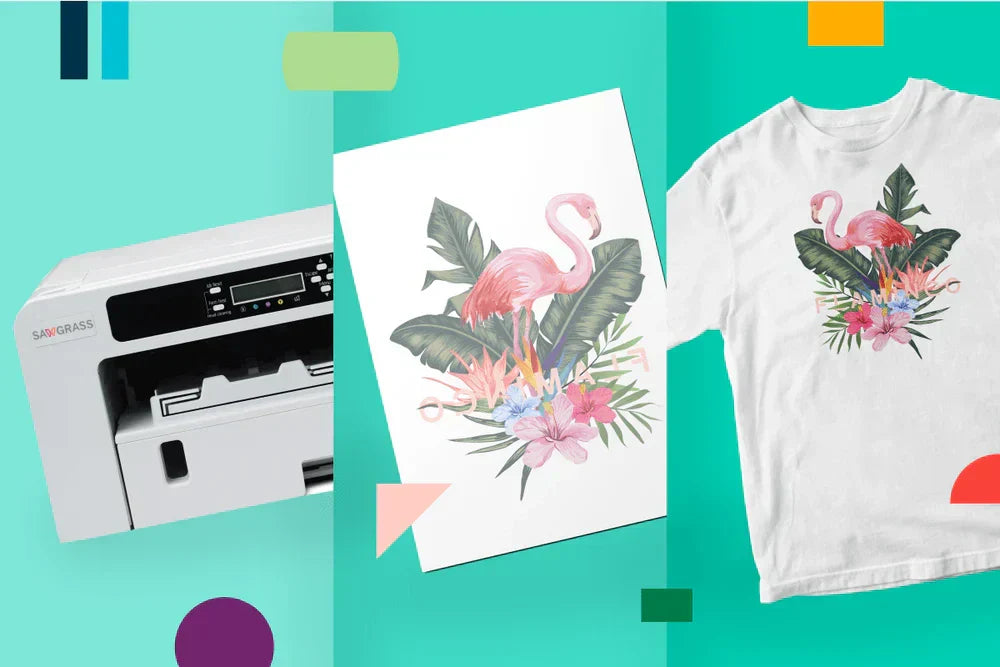
If you've ever thought about what sublimation printing is and the reason behind its popularity, you're in the right place. These days, you can see it everywhere, be it on t-shirts, mouse pads, or coffee mugs. The best thing about sublimation printing is that it does not sit ink on the surface, unlike traditional printing methods such as screen printing.
Therefore, sublimation prints look very smooth and natural. Plus, it also lasts longer! In this guide, we will explain the sublimation printing technique, how it works, its pros and cons, and when to choose it over other printing methods, such as DTG printing or heat transfer vinyl.
What Is Sublimation Printing?
Sublimation printing is a printing technique in which a solid dye converts directly into a gas under heat and pressure, bonding permanently with polyester fibers or polymer-coated surfaces. David Gross, the president of Condé Systems, Inc., says, “I look at sublimation as an enabling technology like electricity…”
The sublimation printing process is based on a simple scientific principle. When subjected to high temperature and pressure, sublimation ink goes through a phase transition. The ink changes from solid to gas, passing through the liquid state.
The gas then goes deep into the surface material at the molecular level. When it cools, it becomes solid again and is thus trapped inside the material. The dye used in the transfer sublimation process bonds with the substrate's surface layer, extending the print's lifespan beyond that of the layer itself and preventing cracking, peeling, or washing away. Besides, this is why sublimation printing is such a successful method for polyesters and coated materials.
How Does Sublimation Printing Work? (Step-by-Step)
Understanding how the sublimation printing process works makes it easier to see why the results are so durable.
- You create your artwork using graphic design software.
- The design is printed with sublimation ink using a sublimation printer or dye-sublimation printer onto sublimation paper, also called transfer paper.
- The printed paper is placed on the product or fabric.
- A heat press applies high temperature, usually around 190 to 205°C, along with firm pressure.
- Through heat and pressure, the sublimation dyes turn into gas and bond at the molecular level with the material.
- Once cooled, the design becomes permanent.
This sublimation process is a clean, low-waste printing method, making it an eco-friendly option.
Materials Used in Sublimation Printing
What Materials Work Best?
Sublimation printers require specific materials to work correctly. The best results come from:
- Polyester fabrics with at least 65 percent polyester
- Polyester materials and synthetic fabrics in general
- Polymer-coated hard surfaces, often called sublimation blanks, such as
- Coffee mugs
- Phone cases
- Photo panels
- Aluminum sheets
- Mouse pads
These materials allow the dye to transfer correctly, producing high-quality, detailed prints with a vibrant print finish.
Materials That Do NOT Work Well
Some materials simply do not react appropriately with the dye sublimation process:
- Cotton fabric without special coating
- Dark fabrics, where colors do not show well
- Untreated wood or metal
- Surfaces that cannot handle pressure transfer and high heat
Issues like white creasing or dull colors can appear if you choose the wrong surface material.
Sublimation Compatibility Chart
| Material | Compatible? | Notes |
|---|---|---|
| Polyester Fabric | Yes | Best results |
| Cotton Fabric | No | Requires coating |
| Ceramic Mug | Yes | Must be polymer-coated |
Types of Sublimation Printing
There are different types of sublimation printing methods that you can try:
Desktop sublimation printing (small businesses)
Among all other printing methods, desktop sublimation printing is the most common choice for beginners and small businesses. This process involves using compact dye sublimation printers, sublimation paper, and a standard heat press.
Therefore, this configuration is suitable if you plan to use sublimation printing for custom apparel, gifts, or similar items. It is a viable option for sublimation t-shirt printing, small amounts, and personal products. The low setup cost makes it achievable while still delivering professional-quality results.
Clever Printing's Tom Heywood, based in Clitheroe, UK, incorporated sublimation printing into his custom product line. He first added printed phone cases and produced them in-house with a dye-sublimation machine after the demand increased. This enabled him to cut down costs and move into more profitable products like t-shirts and wall art. The business has now hired employees and intends to grow more, which is made possible by the versatility and quality that sublimation technology provides. (Case study)
Industrial sublimation printing
The focus of industrial sublimation printing is large-scale production. The system transfers designs not to individual items, but to rolls of transfer paper or fabric. The whole process involves using the most modern dye-sublimation printers with large heat presses or calendar machines. Such a method is suitable in textile and sportswear manufacturing and bulk promotional printing, where speed and consistency are of utmost importance.
Direct-to-fabric sublimation
Direct-to-fabric sublimation is the application of dye directly onto polyester fabric. Thereafter, the fabric goes to the heat fixation stage. This technique applies to continuous textile production and is primarily used in industrial units. It results in faster processing and fewer handling steps than traditional sublimation transfer methods.
Transfer paper sublimation
Transfer paper sublimation is still the most universally accepted sublimation printing method. The first step is to print the designs onto a special transfer paper, then apply it to the products using heat and pressure. This method is quite flexible, and it can be used on both fabrics and hard goods. The process can deliver excellent results, depending on your workflow.
Benefits of Sublimation Printing

Sublimation printing offers a range of benefits beyond delivering professional results. Sublimation printing offers a range of benefits beyond delivering professional results. In fact, the global dye-sublimation printing market is expected to grow to USD 25.52 bn by 2030, as per Mordor Intelligence (Source).
Let's explore the advantages now:
- Durability: One of the most significant benefits is its durability. Since the dye becomes part of the coated surface or the fabric, the print never cracks or fades. Therefore, it is an excellent option for sublimation shorts, polyester t-shirts, and items that are frequently washed.
- Print feel: The best thing about sublimation printing is that the ink does not sit on the surface, and therefore, there are no raised textures. You get a breathable fabric since the dye bonds internally. It is beneficial for sublimation shirt printing or sports where comfort matters a lot.
- Sharp details: With sublimation, you can get high-quality prints without compromising any important detail. You just need to ensure you prepare the graphic design software properly. This will help you get clean edges and vibrant prints.
- Efficient process: As compared to the traditional printing methods, the digital printing process is highly efficient in the sense that it minimizes wasted ink or excess ink. Since there is no physical screen involved, it works well for customization, short runs, and on-demand printing. Many businesses prefer screen printing or sublimation when flexibility matters.
- Eco-friendly process: Sublimation printing is an environmentally friendly process that uses a special ink that turns into gas. This reduces waste and avoids harsh chemicals found in solvent-based systems.
Cons of Sublimation Printing
Sublimation works in some instances, but it has its own limitations.
- The most significant limitation is the materials' compatibility. Sublimation printing needs polyester fabric, polyester materials, or polymer-coated surfaces. Natural fibers, such as cotton, do not work unless specially treated, which decreases the number of products that can be made from sublimation.
- Another limitation is in the colors that can be used. Sublimation cannot print white because it does not use white ink. The base color always comes through; hence, sublimation is best suited for light-colored materials. Dark fabrics often result in either dull or invisible prints.
- Consistency is also critical. The sublimation printing process works only if heat and pressure are applied uniformly. Poor control of the heat press can lead to fading or creasing in white areas. The accurate color of sublimation designs also depends significantly on ICC profiles and printer settings being correct.
Due to these limitations, sublimation can't be the only method compared to other printing techniques in all circumstances. When you understand the benefits, it becomes easier to choose the right printing method for every project.
Conclusion
There are certain occasions where sublimation printing may be the best choice, especially for synthetic and coated products, as well as polyester shirts and other gift items such as coffee mugs or mouse pads. But it has limitations in the choice of materials and ink.
If you are serious about scaling and improving your business, it’s pivotal to invest in a suitable sublimation printer, dye-sublimation inks, and a heat press setup, which will pay off. Power your print business with trusted printers, premium printheads, and expert support from AllPrintHeads. Shop top global brands, get competitive pricing, fast worldwide delivery, and personalized guidance.
Frequently Asked Questions
Is sublimation printing better than vinyl?
For polyester or coated products, sublimation is a better choice than vinyl because it is durable and delivers long-lasting prints.
Are there any cons of sublimation printing?
Yes, there are a few cons! For example, this printing style is suited mainly for polyester materials, has no white ink, and is not compatible with a lot of other materials as well.
Why would anyone use sublimation printing?
The sublimation printing process yields long-lasting results. Plus, they are durable and eco-friendly.
Are normal printers different from sublimation printers?
No. Standard printers are not the same as sublimation printers because the former use liquid ink, while the latter use dye-sublimation inks.
