
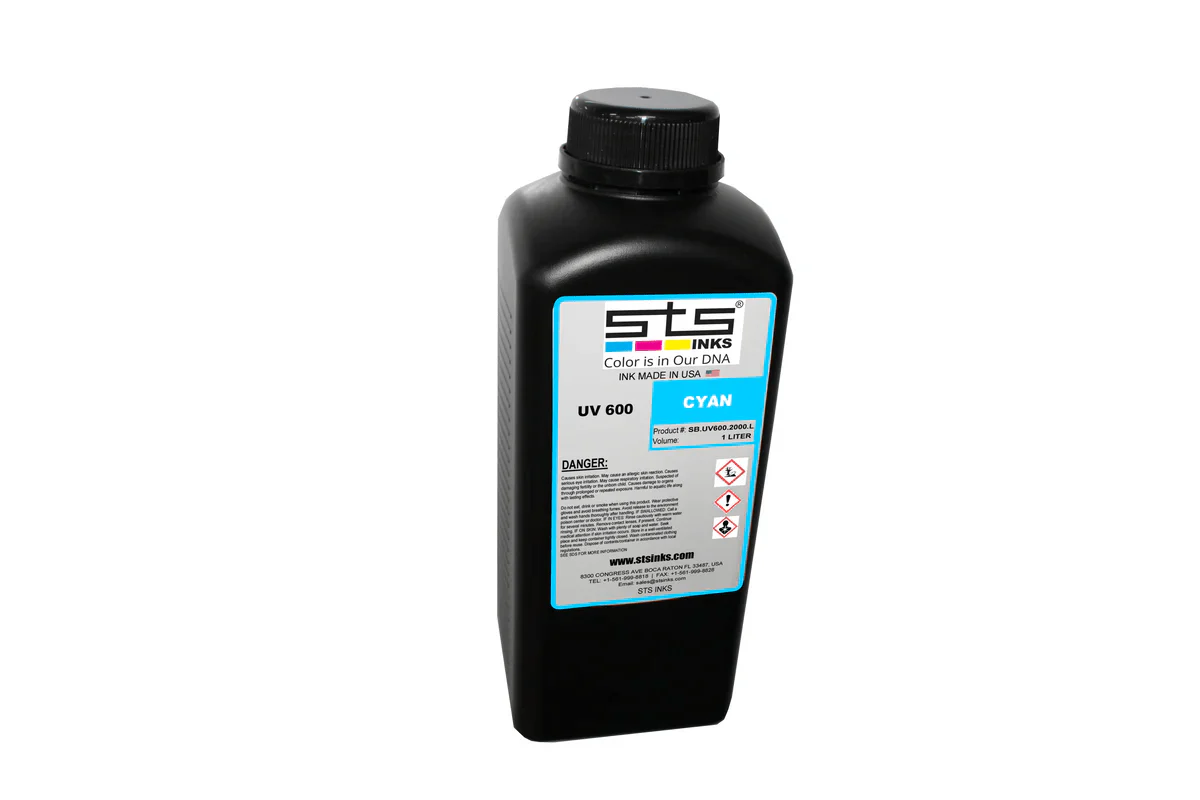
Here's a thing that surprises people when they first work with UV printing: the ink doesn't dry. Not in any traditional sense. It cures. That's a completely different process than what happens with solvent or water-based inks, with different implications for your equipment, substrates, shop environment, and the quality of what comes off the printer.
If you're getting into UV printing or trying to understand the ink side of your existing setup, this is the breakdown you need.
What Is UV Ink?
Most inks dry because the liquid carrier, usually water or a solvent, evaporates, leaving the pigment behind.UV ink doesn't work like that. It stays in liquid form until the moment it hits ultraviolet light, then a chemical reaction fires in fractions of a second, and the ink goes from liquid to a hard, bonded solid on the substrate.
The chemistry behind that reaction starts with photoinitiators, compounds incorporated into the ink formula that absorb UV light and initiate polymerization throughout the entire ink layer. No UV light, no curing. UV light hits, and the ink locks in place.
What you get on the other end is a scratch-resistant layer bonded to the surface rather than absorbed into it. Cleaner edges, better color accuracy, and a harder surface from the moment it cures. That's what separates UV-cured ink from conventional inks that soak partially into the material.
How Is UV Ink Used in Printing?
UV printing ink runs through digital inkjet, flexographic, screen, lithographic, and pad printing processes, giving it reach across industries and printing project types that most other inks can't cover.
The most common applications include:
- Packaging: Folding cartons, labels, and flexible packaging where durability through production and shelf life is critical
- Signage: Indoor and outdoor work where scratch resistance and color vibrancy have to hold long-term
- Industrial applications: Parts marking, component labels, and equipment panels requiring chemical resistance
- Personalized products: Golf balls, promotional merchandise, and custom rigid-substrate work
- Specialty surfaces: Acrylic, wood, metal, glass, plastic, ceramics, and vinyl
UV flatbed printers handle rigid substrates. Roll printers handle flexible media. Picking the right machine for the substrate decides whether the job runs cleanly or gets redone.
For shops running STS inks across UV systems, compatibility between ink and print heads is not an afterthought. It directly affects output consistency and the longevity of the printheads.
Key Benefits of UV Printing Ink
 UV printing ink costs more than most conventional inks. It earns the premium back in ways that show up on the production floor, not just in brochures.
Fast-Drying and Efficient Printing
There's no drying window with UV curable ink. The substrate passes under the UV LED lamps, and the ink is cured before it clears them. Handle it, stack it, move it to finishing. All immediately. No wait time, no smudging risk.
As Ray Weiss, Project Manager at PRINTING United Alliance and 2020 inductee of the Academy of Screen and Digital Printing Technologies, writes in In-Plant Impressions: "UV printers have come a long way from the days when they were strictly flatbed printers using very rigid inks."
Today's UV printer handles flexible substrates, roll media, and shaped objects while keeping that instant-cure efficiency. On high-volume runs, the throughput difference over solvent drying adds up fast, and shops running UV equipment feel it in daily output.
Environmentally Friendly Printing Process
UV curable ink runs up to 99.5% free of volatile organic compounds compared to traditional solvent inks, which release harmful emissions throughout drying as the carrier evaporates into the air. No strong odors from solvent-based inks. No VOC release. For operations in shared buildings or spaces with compliance requirements, that eco-friendly profile is a real operational advantage.
Versatility Across Various Surfaces
Plastic, metal, wood, acrylic, glass, ceramics, vinyl. Those are materials UV printers run on daily, not a list of theoretical possibilities. Hard UV ink creates a scratch-resistant surface on rigid substrates. Soft UV ink stays flexible on rubber and film. Low-migration formulations cover food-safe packaging. Special effect UV inks produce metallic shimmer and textured finishes that water-based ink options simply can't match.
For shops running a Sawgrass sublimation printer alongside UV equipment, the contrast in substrate range is immediate. Sublimation handles polyester and polymer-coated hard goods. UV printing covers nearly everything else.
High-Quality and Durable Prints
UV printing ink sits on the substrate surface rather than being absorbed into it. No bleeding, no spreading. What gets laid down stays where it landed. The cured layer resists smudging, scratching, and fading without lamination or additional finishing. For labels, industrial parts, and surfaces that undergo regular handling, UV printing is the ideal choice when a durable print and superior finishes are required.
Components of UV Ink
Understanding the formulation helps when you're selecting UV ink for a specific UV printer and substrate, or troubleshooting adhesion and curing issues.
Photoinitiators
Photoinitiators remain dormant in the formula until UV light from the UV LED lamps strikes them. They absorb the ultraviolet light, generate free radicals, and initiate polymerization that cures the ink film. Their concentration and type determine curing speed and bond strength under a given lamp output.
Pigments and Colorants
Pigments in UV printing ink are solid particles suspended throughout the formulation, not dissolved into a carrier like dye-based colorants. That structure is what gives UV-cured ink its color stability under prolonged exposure. The pigments are locked into the cured layer, not dispersed into the substrate, so they don't break down over time the way absorbed inks can.
Oligomers and Monomers
Oligomers define the physical characteristics of the cured film: hardness, flexibility, scratch resistance, and surface adhesion. Monomers reduce viscosity for reliable jetting while contributing to cured layer strength. Their ratio in a UV curable ink formula is what separates hard UV ink from softer, flexible formulations.
Additives for Performance
Adhesion promoters improve bonding on difficult surfaces. Stabilizers prevent premature curing when the ink is exposed to direct sunlight or ambient ultraviolet light during storage. Adhesive compounds extend that bonding capability to coated glass and oily plastics, where conventional inks won't hold. Each additive solves a specific problem in real production conditions.
Limitations of UV Ink
UV ink covers a wide range of applications. It doesn't cover all of them.
Not Suitable for Textiles and Clothing
UV ink and fabric don't work together. The cured layer is rigid, so it cracks and peels when the woven material stretches or goes through a wash cycle. For garment and textile printing, DTF inks are formulated specifically for fabric adhesion, stretch recovery, and washability that UV-curable inks can't provide.
Higher Initial and Material Costs
The photoinitiators, oligomers, and additives in UV-curable ink push material costs above those of conventional inks and water-based ink alternatives. Adding the UV printer hardware is a significant upfront investment. For small business operations considering the switch, realistic projections on job volume and margin need to come before the equipment decision.
Specialized Equipment Requirements
Standard printers can't run UV ink. The UV LED curing system is part of the UV printer itself, not a retrofit. That means a full equipment commitment to get started. Proper printer installation matters from day one. Lamp alignment and UV energy output directly affect whether the ink cures completely. Get them wrong and you get incomplete curing, adhesion failures, and damaged material. A professional setup is the right way to protect the investment.
Frequently Asked Questions About UV Ink
What materials can UV ink print on?
Plastic, metal, wood, acrylic, glass, ceramics, vinyl, and paper all work with UV ink, covering most rigid and semi-rigid surfaces print shops deal with. UV flatbed printers handle hard substrates. Roll printers cover flexible media. Surface energy levels and primer requirements vary by material, so running tests before a full production run is worth the time.
What is the difference between UV ink and traditional ink?
Traditional inks dry through evaporation or absorption. UV-cured ink cures instantly when ultraviolet light hits it, with no wait time and a harder, more durable cured surface. UV printing ink also releases far fewer harmful compounds during the process than traditional solvent inks, making it better suited for indoor printing environments and operations with air quality requirements.
Can UV ink be used for packaging and labels?
Yes, and it's used for both regularly. Folding cartons, product labels, flexible packaging. Low-migration UV inks are formulated for food-safe packaging specifically, where adhesive compounds must not migrate into the product or container. On high-speed packaging lines, UV curable ink's instant cure time is a production advantage that conventional inks can't match.
Conclusion: Why UV Ink Is Important in Modern Printing
UV printing ink solves several production problems at once. Fast curing, strong durability, broad surface compatibility, and a lower harmful emissions profile than solvent alternatives. For shops running diverse materials at volume, that combination is difficult to replicate elsewhere.
Know the curing process. Understand which substrates work and which don't. Get printer installation handled properly before production starts. Do those things, and your UV printer performs the way it should. Right ink, right substrate, right setup. Results follow.
