
Your production line is humming. Orders are piling up, and suddenly your printer chokes on a large delivery, and you end up explaining delays to those furious clients.
Sounds familiar? If that’s what you don’t want to deal with, the right industrial printer must be by your side. But what makes an industrial printer the “right” pick? Not specs and that high price tag. It’s the promise and reliability that solidify that this device will protect your brand’s reputation and keep up your production during that peak season.
What is Industrial Printing
As the name says, industrial printing is the large-scale production of printing in a factory or industrial setting. In this kind of production, you’ll often see machines handling large volumes, unusual materials, and on-demand production schedules.
Unlike office printing (that can betray you sometimes and that doesn’t hurt you a lot), industrial printing has to function perpetually. A single minute of delay can lead to $5,600 of IT downtime as per a report.
Industrial printing isn’t a paper-only thing. It uses textiles, vinyl, metal, ceramics, and many other materials you didn’t even know could be printed on. The heavy machinery for industrial printing resides in factories, textile plants, signage shops, and packing facilities as they need to cover all sorts of things, from printing a large banner to small printed tapes.
Types of Industrial Printers

Industrial printing is a huge domain where some players rule. Let’s talk about a few types:
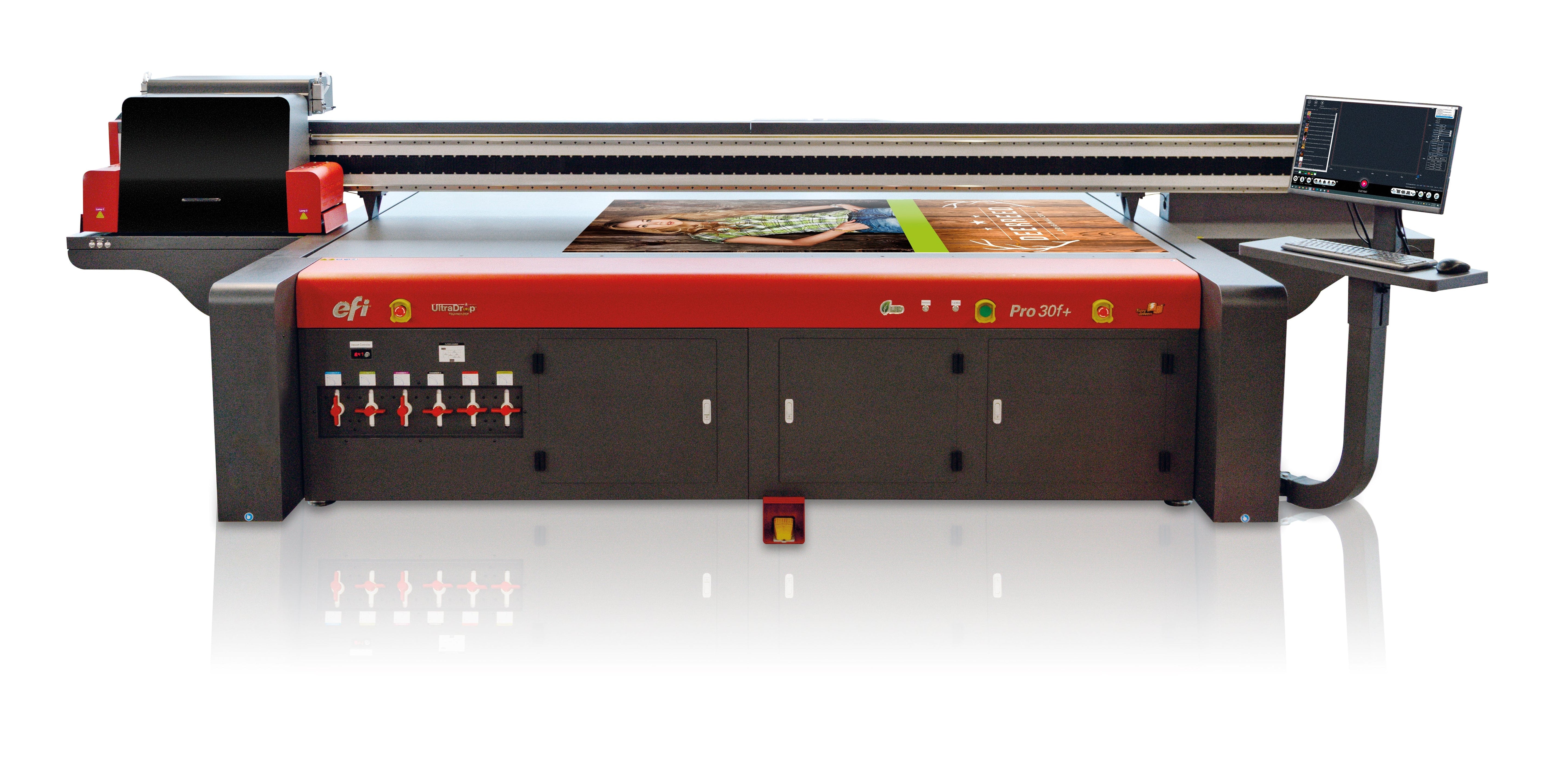
EFI VUTEk Industrial Printers
Always dealing with high volumes of orders? EFI is your printing buddy. The wide-format friendliness of this machine makes it a credible name among signage companies that demand consistent quality at lighting-fast speeds.
Be it a corrugated board, acrylic, or a foam board, the print quality will be sharp and crisp which can outperform your competitors. No waiting time for ink-drying, so the project goes from start to finish in a jiffy.
Mimaki Large-Format Printers
Mimaki is the versatility king. Be it an outdoor banner or interior decor, you’ll witness equal finesse, making this a staple in the fashion and decor industry.
With Mimaki’s advanced printer heads, details and color accuracy are never an issue. From a vehicle wrap to a fine art reproduction, these machines execute those printing projects with consistency across long production runs.
The icing on the cake here is their ecosolvent ink and UV technology. It’s durable and environmentally responsible at the same time.
Industrial Epson DTG Printers
Deal with garment printing? Epson is for you. Direct-to-garment and textile printing have exploded in recent years. Ever saw a custom print on a t-shirt or hoodie? Or a company’s logo on a black polo? That’s DTG printing.
For complex designs and vibrant colors directly on a fabric, home textile, and soft signage, nothing’s better than Epson. If you’re a fashion brand looking to upscale, a custom t-shirt brand, or an on-demand apparel shop, Epson is a flexible, efficient, and cost-effective solution.
Sublimation Printers
Sublimation printing is pure chemistry magic. If you’ve ever been gifted or received a mug with your own picture on it, that was done by a sublimation printer. Just get the setup right, and you can print on fabrics, ceramics, mugs, etc., with a design that doesn’t crack, peel, or fade.
The best outcome of these printers can be seen by pairing them with forever transfer paper. With this paper, sublimation becomes more versatile and gives you neat transfers that are sharp and lively.
Key Factors to Consider When Choosing Industrial Printers
Chasing the newest and shiniest model often doesn’t work. You have to scan your own needs and then the configuration to see what fits your needs.
Production Speed & Capacity
Calculate your actual needs, not your wishful thinking. How many square feet do you need to print daily? Weekly? During your busiest month? The manufacturer’s top speed is just one piece of the puzzle. In real-world production, setup time, material loading, changeovers, etc., matter too.
A slow but consistent printer that runs 20 hours/day will outperform a faster one that always asks for maintenance.
Print Quality Requirements
Not every job needs a museum-quality reproduction.
|
Application |
Quality Level Needed |
|
Outdoor banners |
Good |
|
Retail displays |
Better |
|
Fine art prints |
Best |
|
Industrial labels |
Good to better |
Match your printer’s capabilities to your most demanding regular work. Buying more quality than you need burns the budget. Buying less than you need tarnishes your reputation.
Regulatory Compliance
Now comes the not-so-fancy but integral part. Food packaging has FDA requirements. Children’s products have strict safety standards. Some industries require specific certifications for inks and materials. Do your homework before you buy.
Ease of Operation & Maintenance
An industrial printer is a hefty investment. Look at these aspects to invest in something worthwhile:
- Can your existing team operate it well or do you need experts?
- How quickly can you order printer ink online when you run low?
- Are replacement parts readily available?
- What’s the realistic maintenance schedule?
Complex machines with limited support networks become expensive paperweights. Go for a credible manufacturer who’s known for their quick and on-time printers services. You cannot afford downtime in your large-scale operations.
Why Choosing the Right Industrial Printer Matters

The answer to this is quite straightforward. The right machine increases throughput, reduces waste, and expands your service offerings. You can also promise shorter turnarounds with confidence and deliver on that.
Got the wrong printer?
You’ve already made a six-figure mistake, which will make cost-recovery a battle. If the speed, usability, and quality aren’t up to the mark, you’ll end up missing deadlines, your team’s morale will plummet, and client retention will turn into a dream.
Conclusion
Industrial printing is a large-scale job where a single machine can impact production, client satisfaction, revenue, and more. It’s not like that tiny office printer that doesn’t actively participate in your daily workflow.
While choosing an industrial printer, go ahead and understand your needs. Types of substrate you print on. Number of orders. Your team’s expertise level. Once you have a clear idea of your requirements, find something that fulfills these requirements.
At Allprintheads, we provide a comprehensive range of printing solutions, from industrial and medium to entry-level systems. We also offer a full portfolio of parts and expert technical services. Contact us to discuss your requirements.

2 Kommentare
JAIME
Dear Dada,
While we supply parts and consumables worldwide, we unfortunately do not sell or service printers internationally at this time, as our technical support team is currently based solely in the US.
For textile printers, we highly recommend industry leaders such as Epson, Mimaki, DGI, and EFI, which excel in the sublimation and DTF (Direct-to-Film) space.
If you have any further questions, please feel free to reach out to us at customerservice@allprintheads.com. Thank you for your inquiry and feedback.
Best regards,
The Allprintheads.com Team
Dada Segwe
1.I’m based in South Africa Do you have any one to assist with requirements.
2.What are the list of 5 Best large format Brands for textile Printing